

The way construction companies win projects has changed. For years, many contractors in the Greater Toronto Area relied on referrals, industry relationships, repeat clients, and word of mouth to keep their pipeline moving. Those channels still matter, but they are no longer enough on their own.
Today, developers, property managers, architects, procurement teams, institutional buyers, and commercial decision-makers often research construction firms online before making contact. They review portfolios, safety records, project experience, service pages, Google Business Profiles, LinkedIn activity, case studies, and client testimonials long before a formal bid conversation begins.
That is why digital marketing for construction companies is no longer just about having a website or running a few ads. It is about building a digital presence that creates trust, proves capability, supports long sales cycles, and helps your company get considered for better projects.
For construction firms in Toronto, Mississauga, Vaughan, Brampton, Hamilton, and across Ontario, a strong digital strategy can help turn your website from a basic online brochure into a serious business development asset.
In this guide, we will break down the most important parts of construction marketing, including SEO, local search, website structure, LinkedIn, paid campaigns, case studies, reputation management, and lead tracking.
Why Digital Marketing for Construction Companies Is Different
Construction marketing is not the same as marketing for retail, real estate, restaurants, or local home services. The buying process is longer, the risks are higher, and the decision usually involves several stakeholders.
A commercial construction project may take months or years to move from early research to a signed contract. During that time, your potential client may compare several contractors, review past projects, check safety credentials, speak with consultants, and evaluate whether your company can deliver on budget and on schedule.
That means your marketing cannot rely only on quick sales messages. It needs to build confidence at every stage.
Construction Marketing vs. Real Estate Marketing
| Area | Real Estate Marketing | Construction Company Marketing |
|---|---|---|
| Main audience | Buyers, renters, investors | Developers, procurement teams, architects, owners, property managers |
| Sales cycle | Often shorter | Usually longer and more complex |
| Main emotional driver | Lifestyle, investment, urgency | Risk reduction, reliability, technical ability |
| Best proof assets | Listings, photos, virtual tours | Case studies, safety records, project timelines, certifications |
| Conversion goal | Book a showing, request info, buy/rent | Request a bid, submit RFP, book consultation, pre-qualify vendor |
| Content focus | Property features and location | Capability, compliance, process, budget control, project delivery |
For construction firms, marketing must answer one main question:
Can this company be trusted to deliver a complex project safely, professionally, and profitably?
Everything on your website, portfolio, Google profile, LinkedIn page, and landing pages should help answer that question.
The Long-Cycle Nature of Construction Lead Generation
A person looking for a product online may buy within minutes. A developer choosing a contractor for a commercial build will not.
In construction, buyers usually move through several stages:
- They identify a future project need.
- They research possible contractors.
- They compare experience and project types.
- They check credibility, safety, and reputation.
- They shortlist companies.
- They request proposals or bids.
- They negotiate details.
- They make a final decision.
Because this process takes time, your marketing needs to stay visible throughout the journey. A single website visit is rarely enough.
That is where SEO, retargeting, email follow-up, Social Media content, and strong case studies work together. The goal is not just to get traffic. The goal is to stay present in the mind of the decision-maker until they are ready to act.

Multiple Stakeholders Mean Multiple Marketing Messages
Large construction decisions rarely come from one person. A commercial or institutional project may involve:
- Property owners
- Developers
- Architects
- Engineers
- Municipal procurement teams
- Financial decision-makers
- Operations managers
- Safety officers
- Project managers
- Legal or compliance teams
Each group cares about something slightly different.
| Stakeholder | What They Care About | Best Content to Show Them |
|---|---|---|
| Developer | Speed, budget, ROI, risk control | Case studies, cost-control content, timelines |
| Architect | Design integrity, coordination, execution quality | Portfolio pages, project photos, technical process content |
| Engineer | Technical capability, problem-solving, site conditions | Methodology articles, complex project breakdowns |
| Property manager | Reliability, minimal disruption, communication | Maintenance, renovation, and phased-work case studies |
| Procurement officer | Compliance, documentation, safety, vendor reliability | Certifications, safety records, pre-qualification pages |
| Business owner | Trust, cost, timeline, finished result | Service pages, testimonials, before/after examples |
This is why a generic “we are the best contractor” message does not work well. Your website should speak to different buyer concerns through different pages and content formats.
Build Trust With Proof, Not Claims
Google’s quality guidelines often discuss experience, expertise, authoritativeness, and trustworthiness. For construction companies, these ideas are not just SEO concepts. They are also business development essentials.
A construction company cannot build trust with vague claims like “high quality work” or “experienced team.” Those statements are common and easy to ignore.
Instead, you need to prove your credibility.
Strong Trust Signals for Construction Websites
Your website should clearly display:
- Completed project examples
- Real project photography
- Before-and-after photos
- Safety certifications
- Insurance and bonding information where appropriate
- Years of experience
- Service areas
- Client testimonials
- Industry memberships
- Project timelines
- Team or leadership profiles
- Case studies with measurable outcomes
- Clear contact and pre-qualification options
If you serve commercial or municipal clients, make it easy for procurement teams to verify your qualifications. If you serve developers, show that you understand schedule pressure, budget control, and coordination with architects and consultants.
Replace Stock Photos With Real Project Evidence
Generic hardhat stock photos are weak. They may make a website look polished, but they do not prove anything about your company.
Real project photography is much more powerful. Show actual crews, equipment, job sites, completed builds, restoration work, concrete pours, structural work, renovations, or commercial interiors. Even simple project photos can build more trust than perfect stock imagery.
Better yet, turn your projects into case studies.
A strong construction case study should include:
- Project type
- Location
- Scope of work
- Client challenge
- Timeline
- Site constraints
- Materials or methods used
- Safety considerations
- Final outcome
- Photos or video
- Testimonial, if available
For example, instead of saying:
We complete commercial projects on time and on budget.
Say:
For a commercial renovation in Mississauga, our team completed phased construction while the facility remained operational. The project required off-hour scheduling, dust control, supplier coordination, and weekly progress reporting to reduce disruption for staff and visitors.
That kind of detail feels real. It also gives search engines and users more context about your expertise.
Understand Your Construction Audience in the GTA
The Greater Toronto Area is a competitive and diverse construction market. A contractor may be trying to reach commercial developers in Toronto, industrial property owners in Mississauga, institutional buyers in Vaughan, or high-end residential clients in Oakville.
Each audience has different priorities.
GTA Construction Audience Segments
| Audience | Main Pain Points | Content That Works |
|---|---|---|
| Commercial developers | Delays, budget overruns, contractor reliability | Case studies, scheduling process, design-build pages |
| Industrial property owners | Downtime, safety, operational disruption | Industrial renovation pages, phased-work examples |
| Institutional buyers | Compliance, safety, documentation | Safety pages, certifications, procurement-friendly pages |
| Property managers | Fast response, minimal disruption, clear communication | Maintenance and renovation service pages |
| High-end residential builders | Finish quality, design accuracy, premium materials | Portfolio galleries, craftsmanship content |
| Architects and consultants | Coordination, technical execution, documentation | Technical project breakdowns and collaboration process pages |
The more specific your content is, the more likely it is to attract the right type of lead.
A general article about “construction services” may be too broad. But a page about “commercial renovation contractor in Toronto” or “industrial concrete contractor in Mississauga” can attract users with much stronger intent.
Website Architecture: Turn Your Site Into a Digital Sales Tool
Your website is the foundation of your digital marketing strategy. A weak website makes your company look less credible, even if your actual work is excellent.
For construction companies, the website should not simply say who you are. It should help potential clients understand what you do, where you do it, who you serve, and why they should trust you.
Essential Pages for a Construction Company Website
| Page Type | Purpose |
|---|---|
| Homepage | Communicate positioning, service areas, trust signals, and main services |
| About page | Build credibility through company story, leadership, values, and experience |
| Service pages | Target specific commercial, industrial, residential, or specialty services |
| Location pages | Capture local searches in Toronto, Mississauga, Vaughan, Brampton, etc. |
| Case studies | Prove experience with real project examples |
| Portfolio/gallery | Show visual proof of completed work |
| Safety/compliance page | Support trust for commercial and institutional buyers |
| Blog/resource section | Answer questions and attract early-stage search traffic |
| Contact page | Make it easy to request a consultation, bid, or callback |
| Pre-qualification/RFP page | Help serious buyers submit project details efficiently |
A common mistake is sending all traffic to the homepage. That is not ideal.
If someone searches for “commercial general contractor Toronto,” they should land on a page specifically about commercial general contracting in Toronto. If someone searches for “industrial renovation contractor Mississauga,” they should land on a page focused on industrial renovations in Mississauga.
Specific pages convert better because they match the searcher’s intent.
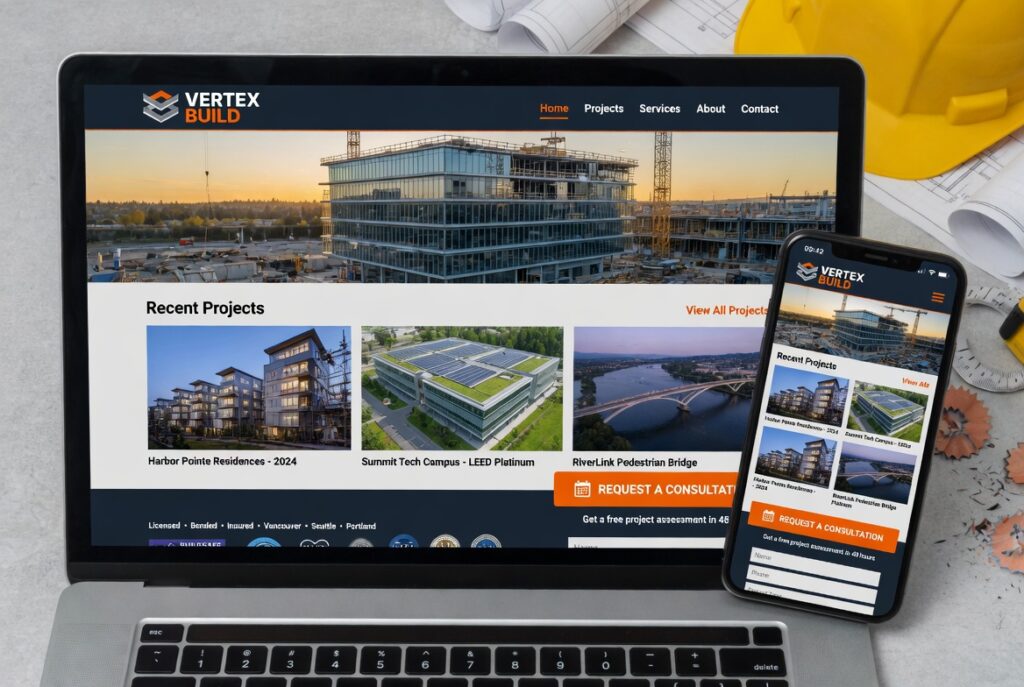
High-Converting Landing Pages for Construction Leads
A landing page should be built around one specific service, audience, or campaign.
For example, if you are running ads for commercial concrete work, do not send users to a generic homepage. Send them to a landing page about commercial concrete services, with relevant photos, project examples, trust signals, and a clear call to action.
Construction Landing Page Checklist
A good construction landing page should include:
- Clear headline matching the service
- Local relevance, such as Toronto or GTA service area
- Short explanation of who the service is for
- Real project photos
- Key capabilities
- Safety and compliance signals
- Case study or testimonial
- Simple contact form
- Phone number
- Strong call to action
- FAQ section
- Internal links to related services
Example CTA:
Planning a commercial construction project in the GTA? Speak with our team about your scope, timeline, and project requirements.
This is stronger than a generic “Contact us today” because it speaks directly to the buyer’s situation.
Local SEO for Construction Companies in Toronto and the GTA
Local SEO helps your company appear when people search for construction services in specific cities or regions.
For example:
- commercial general contractor Toronto
- construction company Mississauga
- industrial contractor Vaughan
- commercial renovation contractor Brampton
- design-build construction company Ontario
- concrete contractor GTA
These searches are valuable because they usually come from people looking for a real provider, not just general information.
Local SEO Page Strategy
| Target Page | Example Keyword |
|---|---|
| Main service page | Commercial construction company Toronto |
| Location page | General contractor Mississauga |
| Specialty page | Industrial concrete contractor Vaughan |
| Project type page | Commercial renovation contractor Brampton |
| Regional page | Construction company Greater Toronto Area |
| Case study page | Commercial build-out project in Toronto |
Local SEO is not only about adding city names to a page. The content must feel genuinely local.
A strong local page should mention:
- The city or region served
- Relevant project types
- Local business needs
- Service process
- Real project examples, if available
- Nearby areas served
- Clear contact details
- Google Business Profile consistency
- Local schema markup
Local SEO helps your company appear when potential clients search for construction services nearby; for an overview of local search optimization, see Local search engine optimisation on Wikipedia.
Google Business Profile and Map Pack Visibility
For many construction-related searches, Google may show a local map pack. This is especially important for contractors that serve specific cities or regions.
Your Google Business Profile should be complete and accurate. It should include:
- Correct business name
- Service categories
- Phone number
- Website URL
- Address or service area
- Business hours
- Service descriptions
- Photos of real projects
- Reviews
- Updates/posts
- Questions and answers
Project photos can help demonstrate real activity across your service area. If your company works throughout the GTA, regular project updates from Toronto, Mississauga, Vaughan, Brampton, Markham, Hamilton, and nearby areas can support stronger regional relevance.
Reviews also matter. A steady review strategy can help your profile look more trustworthy to both users and search engines.
To ensure your construction company ranks well in local searches, follow Google’s official tips to improve your local ranking on Google Business Profile.
Content Marketing: Become the Contractor Buyers Trust Before the Bid
Content marketing is not about publishing random blog posts. For construction companies, the best content helps buyers make better decisions and reduces uncertainty before they contact you.
Strong construction content should answer practical questions, such as:
- How do I choose a commercial contractor?
- What should be included in a construction RFP?
- How can project delays be reduced?
- What is the difference between general contracting and design-build?
- What should property managers know before planning a commercial renovation?
- How do contractors manage construction safety on active sites?
- How do material shortages affect commercial construction timelines?
This kind of content can attract early-stage buyers before they are ready to request a quote. It also positions your company as a helpful expert instead of just another vendor.
Content Ideas for Construction Companies
| Content Topic | Search Intent | Best CTA |
|---|---|---|
| How to choose a commercial contractor in Toronto | Research/comparison | Book a project consultation |
| Commercial renovation checklist | Planning | Download checklist or request review |
| Design-build vs general contracting | Education | Speak with a construction advisor |
| How to reduce construction delays | Problem-solving | Discuss your timeline |
| What to include in a construction RFP | Procurement support | Request pre-qualification info |
| Industrial renovation without shutting down operations | High-intent problem | Schedule a site assessment |
| Construction cost control strategies | Budget concern | Talk to our estimating team |
A strong blog strategy should connect back to your money pages. Every article should internally link to a relevant service page, location page, case study, or contact page.
For example:
- An article about commercial renovation planning should link to your commercial renovation service page.
- A blog about choosing a contractor in Toronto should link to your Toronto construction company page.
- A guide about RFP preparation should link to your pre-qualification or contact page.
Case Studies: The Most Valuable Content Asset for Construction Companies
For many construction firms, case studies are more persuasive than blog posts.
A case study shows that your company has solved real problems in real environments. It can help convince developers, architects, property managers, and procurement officers that you are capable of handling their project.
Case Study Structure
Use this format:
- Project Overview
Briefly explain the project type, location, and scope. - Client Challenge
Explain the problem, constraint, or goal. - Our Approach
Describe how your team planned and executed the work. - Project Constraints
Mention challenges like tight timelines, occupied buildings, weather, logistics, permits, or material coordination. - Outcome
Explain the final result, timeline, quality, or measurable improvement. - Photos and Visual Proof
Add real photos, videos, drone footage, or before-and-after visuals. - Related Services
Link to the service pages connected to the project.
Example internal links to include:
- [Commercial Construction Services]
- [Design-Build Services]
- [Commercial Renovation Services]
- [Construction Case Studies]
- [Request a Project Consultation]
Social Media for Construction Companies: LinkedIn, YouTube, Instagram, and Retargeting
Social media for construction companies should not be random. It should support credibility, recruitment, visibility, and lead nurturing.
Different platforms serve different purposes.
Best Social Channels for Construction Marketing
| Channel | Best Use |
|---|---|
| B2B visibility, developer relationships, executive content, hiring | |
| YouTube | Project walkthroughs, time-lapse videos, educational explainers |
| Visual portfolio, behind-the-scenes content, completed projects | |
| Local visibility, retargeting, community credibility | |
| Meta Ads | Retargeting and brand awareness |
| LinkedIn Ads | Account-based marketing for specific companies or roles |
Organic Social Media
Organic social media content builds authority over time. It is especially useful for showing active projects, company culture, team expertise, and completed work.
Good organic content ideas include:
- Project milestone posts
- Before-and-after images
- Drone videos
- Site safety updates
- Team introductions
- Project manager insights
- Material delivery or installation process
- Completed project walkthroughs
- Community involvement
- Hiring posts
Paid Social Media
Paid campaigns can help speed up visibility and keep your company in front of warm prospects.
For example:
- Run LinkedIn ads targeting developers, architects, and property managers.
- Use retargeting ads for people who visited your service pages.
- Promote case studies to users who viewed your portfolio.
Paid ads work best when your landing pages are specific and your tracking is properly configured.
SEO Strategy for Construction Companies
SEO is one of the strongest long-term channels for construction firms because it captures people who are already searching for your services.
A strong construction SEO strategy usually includes:
- Technical SEO
- Keyword research
- Service page optimization
- Local SEO
- Blog content
- Case studies
- Internal linking
- Schema markup
- Google Business Profile optimization
- Review strategy
- Conversion tracking
Keyword Mapping Example
| Page | Primary Keyword | Supporting Keywords |
|---|---|---|
| Homepage | Construction company Toronto | GTA contractor, construction services Ontario |
| Service page | Commercial general contractor Toronto | commercial construction contractor, general contracting services |
| Service page | Design-build construction company | design-build contractor, commercial design-build |
| Location page | Construction company Mississauga | general contractor Mississauga, commercial contractor Mississauga |
| Blog post | How to choose a commercial contractor | contractor selection checklist, construction RFP tips |
| Case study | Commercial renovation project Toronto | office renovation Toronto, commercial build-out |
Do not try to target every keyword on one page. Each important service, location, and project type should have its own optimized page.
Technical SEO and Website Performance
A beautiful website is not enough. Your site also needs to be technically clean.
Construction buyers often browse from mobile devices, job sites, offices, and tablets. If your site is slow, confusing, or hard to navigate, you may lose serious leads.
Technical SEO Checklist
Your website should have:
- Fast loading speed
- Mobile-friendly design
- Clear navigation
- Optimized title tags
- Strong meta descriptions
- Proper heading tags structure
- Compressed images
- Descriptive image alt text
- Clean URLs
- XML sitemap
- Robots.txt configured correctly
- LocalBusiness or Organization schema
- Service schema where appropriate
- FAQ schema for important pages
- Internal links between related pages
- No broken links
- No duplicate important pages
- Secure HTTPS
For a full overview of SEO best practices, consult Google’s SEO Starter Guide
Reputation Management and Review Systems
Your reputation can influence whether a potential client contacts you, shortlists you, or removes you from consideration.
Reviews are especially important for local visibility and trust. A construction company should have a process for collecting reviews after successful milestones or completed projects.
Review Collection Process
A simple review system could look like this:
- Project milestone completed
- Client receives follow-up email
- Client is asked for feedback
- Happy clients receive a review request link
- Review is published on Google or another relevant platform
- Strong testimonials are reused on website service pages
- Negative feedback is handled privately and professionally
Do not wait until the end of the year to ask for reviews. Build review requests into your normal project closeout process.
Where to Use Testimonials
Use testimonials on:
- Homepage
- Service pages
- Location pages
- Case studies
- Landing pages
- Google Business Profile
- Proposal documents
- LinkedIn posts
A testimonial placed near a contact form can improve conversion because it gives the visitor reassurance at the exact moment they are deciding whether to reach out.
Tracking the Metrics That Actually Matter
Many contractors look at the wrong marketing numbers. Website traffic, impressions, and social media likes can be useful indicators, but they do not prove business growth on their own.
The metrics that matter most are tied to qualified leads and revenue opportunities.
Important Construction Marketing KPIs
| Metric | Why It Matters |
|---|---|
| Qualified consultation requests | Shows actual buyer interest |
| RFP downloads or submissions | Indicates serious commercial intent |
| Pre-qualification form completions | Shows procurement readiness |
| Phone calls from service pages | Measures high-intent response |
| Case study views | Shows trust-building engagement |
| Returning visitors | Helps track long buying cycles |
| Cost per qualified lead | Measures campaign efficiency |
| Pipeline value | Connects marketing to potential revenue |
| Closed deals from marketing sources | Shows true ROI |
Because construction sales cycles are long, attribution can be complicated. A lead may first discover your company through Google, return through LinkedIn, read a case study weeks later, and then submit a form after a referral conversation.
That is why tracking should include:
- GA4 events
- Call tracking
- CRM integration
- Form tracking
- UTM parameters
- Landing page conversion tracking
- Lead source reporting
- Pipeline-stage reporting
The goal is to understand which marketing channels are producing real business opportunities, not just traffic.

Example Digital Marketing Strategy for a GTA Construction Company
Here is what a practical strategy could look like for a mid-sized construction company in the Greater Toronto Area.
Month 1: Foundation
- Audit the current website
- Review rankings and competitors
- Fix technical SEO issues
- Improve homepage messaging
- Set up GA4 and conversion tracking
- Optimize Google Business Profile
- Identify core services and locations
- Build keyword map
Month 2: Core Pages
- Create or improve service pages
- Build location pages for key cities
- Add trust signals and project photos
- Add clear calls to action
- Improve internal linking
- Add FAQ sections
- Optimize title tags and meta descriptions
Month 3: Authority Content
- Publish case studies
- Create blog content for high-intent topics
- Build a LinkedIn content calendar
- Add project galleries
- Create downloadable checklists or RFP guide
Month 4: Paid Campaigns and Retargeting
- Launch Google Ads for high-intent keywords
- Launch LinkedIn awareness or ABM campaign
- Retarget website visitors with case studies
- Test landing page messaging
- Track lead quality
Month 5 and Beyond: Optimization
- Improve pages based on performance
- Build more case studies
- Expand location targeting
- Add new service-specific content
- Improve conversion rates
- Review lead quality with the sales team
- Scale campaigns that produce qualified leads
This type of strategy is stronger than simply posting blogs or running ads without a plan. It connects SEO, content, paid media, and conversion tracking into one growth system.
Common Digital Marketing Mistakes Construction Companies Make
Many construction companies invest in marketing but do not get the results they expected. Usually, the problem is not one single thing. It is a combination of weak strategy, unclear messaging, and poor tracking.
Mistake 1: Using a Generic Website
A website that only says “we offer quality construction services” is not enough. Buyers need details, proof, photos, service pages, and clear reasons to trust you.
Mistake 2: Not Showing Real Projects
If your website has no case studies or project photos, it becomes harder for potential clients to judge your capability.
Mistake 3: Targeting Keywords That Are Too Broad
Ranking for “contractor” is difficult and often too vague. More specific terms like “commercial renovation contractor Toronto” usually have stronger intent.
Mistake 4: Ignoring Local SEO
If you serve the GTA, your website should clearly reflect your local service areas.
Mistake 5: Sending Paid Traffic to the Homepage
Paid traffic should go to relevant landing pages, not a generic homepage.
Mistake 6: Measuring Only Traffic
Traffic is useful, but leads, calls, RFP submissions, and pipeline value matter more.
Mistake 7: Publishing Blog Posts Without Internal Links
Every useful blog should support your service pages, case studies, or conversion pages.
FAQ: Digital Marketing for Construction Companies
Digital marketing helps construction companies become visible when potential clients search online. A strong strategy can attract leads through SEO, Google Business Profile, service pages, case studies, paid ads, LinkedIn, and retargeting. The goal is to generate qualified project inquiries, not just website traffic.
Yes. SEO is important because many developers, property managers, and business owners search online before contacting a contractor. Ranking for service and location-based keywords can help your company appear in front of people actively looking for construction services.
There is no single best channel for every company. SEO is strong for long-term lead generation, Google Ads can capture immediate demand, LinkedIn is useful for B2B visibility, and case studies help build trust. The best results usually come from combining several channels.
Google Ads can work well when campaigns target high-intent keywords and send users to specific landing pages. For example, ads for “commercial contractor Toronto” should lead to a commercial contractor landing page, not a generic homepage.
Yes. LinkedIn can be effective for construction companies that want to reach developers, architects, engineers, property managers, procurement teams, and commercial decision-makers. It is especially useful for thought leadership, project updates, hiring, and account-based marketing.
A strong construction website should include service pages, project photos, case studies, testimonials, safety and compliance information, location pages, clear calls to action, contact forms, and mobile-friendly design. It should make it easy for serious buyers to understand your capabilities.
SEO usually takes time. Some improvements may appear within a few months, but competitive construction keywords often require ongoing work for six months or longer. Results depend on your website quality, competition, content, backlinks, local SEO, and technical performance.
Conclusion: Build a Construction Marketing System, Not Just a Website
Digital marketing for construction companies is not about chasing clicks or posting random content. It is about building a reliable system that supports trust, visibility, lead generation, and long-term business growth.
For construction firms in Toronto and the Greater Toronto Area, the opportunity is clear. Buyers are researching online before they ever speak with your team. If your website, Google profile, case studies, and service pages do not show your credibility, you may lose opportunities before you even know they exist.
A strong construction marketing strategy should include:
- A clear website structure
- Service and location pages
- Local SEO
- Google Business Profile optimization
- Real project photos
- Detailed case studies
- Helpful educational content
- LinkedIn visibility
- Paid campaign support
- Review generation
- Lead tracking
- Conversion-focused landing pages
When these pieces work together, your online presence becomes more than a brochure. It becomes a growth engine.
If your construction company wants to attract better leads, strengthen its digital authority, and compete for higher-value projects, i3ci can help build a strategy tailored to your market, services, and business goals.
Ready to improve your construction company’s online presence?
Contact i3ci to discuss a custom digital marketing strategy for your construction business.