


In the fast-moving Greater Toronto Area real estate market, SEO for real estate developers is no longer optional. In 2026, the GTA market is defined by elevated inventory, flat pricing, and longer transaction timelines. According to TRREB’s April 2026 Market Watch, the GTA continues to see elevated inventory levels and longer selling times, with buyers taking more time to compare options.
In a climate where buyers are highly selective, traditional awareness campaigns are not enough. SEO for real estate developers is the antidote to a slower market. Deep, informative organic content builds the trust required to keep a project on a buyer’s shortlist, putting your developments in front of motivated buyers, investors, partners, and stakeholders at the exact moment they are researching their next move.
Whether you are launching a mid-rise in Vaughan, a townhouse community in Mississauga, or a landmark condo in downtown Toronto, a strategic SEO strategy as a part of a digital marketing strategy for real estate developers helps your developments rise above the noise, attract qualified demand, and build long-term brand visibility.
This guide breaks down how SEO works for real estate developers in 2026. You will see how search supports the full buyer journey, when developers should start their campaigns, how to optimize for AI search engines, and how organic visibility can attract investors and construction partners.
Why Real Estate Developer Marketing Requires a Strong SEO Foundation
The GTA real estate landscape remains competitive and complex. Rising construction costs, shifting buyer sentiment, and increased competition mean developers need a multi-channel approach to growth.
Organic search is especially valuable because it compounds. Once project pages, neighbourhood guides, and supporting content begin to earn authority, they continue to generate qualified traffic and leads long after publication. Unlike broad advertising campaigns, SEO for real estate developers targets people who are actively evaluating options, making it highly valuable for both sales teams and partnership development.
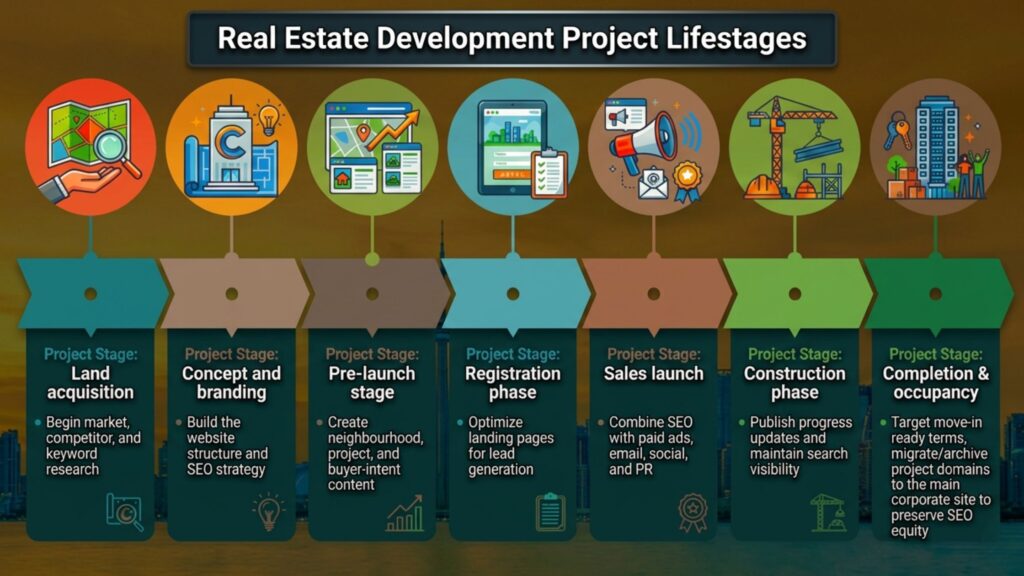
The Timeline: When Should Developers Start SEO?
One of the biggest mistakes developers make is waiting too long to build a website or begin their SEO strategy. Many teams start thinking about search visibility only when sales are about to launch. By that point, paid advertising may create immediate traffic, but SEO needs several months to build authority, rankings, and consistent organic leads.
For real estate developers, the best time to start SEO is early in the project lifecycle, ideally as soon as the development has a confirmed concept, location, and preliminary brand direction.
| Project Stage | The SEO Play |
|---|---|
| Land acquisition | Begin market, competitor, and keyword research |
| Concept and branding | Build the website structure and SEO strategy |
| Pre-launch stage | Create neighbourhood, project, and buyer-intent content |
| Registration phase | Optimize landing pages for lead generation |
| Sales launch | Combine SEO with paid ads, email, social, and PR |
| Construction phase | Publish progress updates and maintain search visibility |
| Completion and occupancy | Target move-in ready terms; migrate or archive project domains to the main corporate site to preserve SEO equity |
Early SEO helps developers build demand before the sales push begins. Neighbourhood guides, transit-focused pages, and project updates can start attracting attention long before a prospect is ready to register.
Generative Engine Optimization (GEO) and AI Search
The biggest shift in real estate developer marketing in 2026 is the rise of AI Overviews and Answer Engine Optimization (AEO). Today’s buyers are increasingly asking AI models complex, hyper-specific questions such as: “What are the new pre-construction condos near the Vaughan Metropolitan Centre with 2-bedroom floor plans under $800k?”
Structuring Data for AI Models
To ensure your development is recommended as the definitive answer, your technical SEO must prioritize schema markup. Using JSON-LD structured data is no longer just about getting rich snippets in Google search results. By implementing the RealEstateListing schema nested with specific Offer and FloorPlan data, you feed your factual data (starting prices, unit availability, square footage, and amenities) directly to search engines. This allows AI models to confidently cite your project as the primary source of truth.
For official schema documentation, see the RealEstateListing structured data specification on Schema.org.
SEO’s Role in the Real Estate Buyer Journey
Real estate buyers rarely make decisions after one search. They move through a journey of exploring the market, comparing projects, reviewing details, and eventually taking action.
Awareness Stage: Reaching Early Researchers
Potential buyers are exploring the market. They may not know your project yet, but they are searching for locations, property types, and future opportunities. Developers should create neighbourhood guides and market overview articles to capture these early researchers.
| Keyword Example | Search Intent |
|---|---|
| New condo developments Toronto 2027 | Exploring future condo options |
| Upcoming townhouse projects Vaughan | Searching by property type and location |
Consideration Stage: Helping Serious Prospects Compare
Searchers are more focused. They are comparing projects, evaluating locations, and looking for floor plans, incentives, or pricing. Strong consideration-stage SEO includes clear navigation, high-quality photography, and seamless internal linking connecting neighbourhood pages with project details.
| Keyword Example | Search Intent |
|---|---|
| GTA condo vs townhouse comparison | Comparing property types |
| [Project name] floor plans and pricing | Evaluating a specific development |
Decision Stage: Converting Search Intent Into Leads
Buyers are close to taking action. They are looking for registration details, sales centre information, and direct contact options. Landing pages at this stage must be fast, secure, and conversion-focused with strong calls-to-action.
| Keyword Example | Search Intent |
|---|---|
| Register for [development] GTA | Ready to submit interest |
| Townhouse developments Vaughan sales centre | Looking for contact or visit details |

Local SEO: Capturing High-Intent Geographic Queries
Local SEO for real estate developers is especially important because buyers search with specific geographic intent. In the GTA, people look for developments near transit, employment hubs, and emerging growth areas.
Effective local SEO for real estate developers includes:
- Transit-Oriented Search: Content specifically highlighting proximity to the TTC subway, GO Transit lines, or the Ontario Line.
- Dedicated Landing Pages: For priority neighbourhoods and project clusters.
- Google Business Profiles: Optimized and updated listings for sales centres.
- Location-Specific Schema: Markup to reinforce the project’s exact geographic advantages.
Beyond Buyers: Attracting Investors, Partners, and Stakeholders
One of the most overlooked benefits of SEO for real estate developers is its ability to create visibility across the entire B2B development ecosystem.
Attracting Capital and Joint Ventures
Institutional and private investors heavily research a developer’s track record, pipeline, and market positioning. SEO supports this by making the right information easy to find. Useful content includes completed project case studies, pipeline overview pages, and joint venture opportunity pages.
Securing Construction Partners and Trades
Trades and suppliers research developers online to understand project pipelines and professionalism. Developers can improve visibility with corporate pages that showcase active projects, construction timelines, and vendor inquiry forms.
Supporting Government and Planning Conversations
When a developer has well-structured content around housing supply, sustainability, community benefits, and transit-oriented development, it reinforces credibility with government officials, planners, and regulatory stakeholders.
Measuring SEO Success in Real Estate
SEO performance should be measured against business outcomes, not just rankings. Important metrics include:
- Organic traffic to project and neighbourhood pages
- Lead form submissions (registrations) from organic search
- Brand search growth over time
- Investor or partner inquiries from search
The developers who win in 2026 treat SEO for real estate developers as a core business function rather than a marketing afterthought. They build dedicated project content early, optimize for Answer Engine Optimization (AEO), preserve equity by archiving completed projects, and measure performance against real business outcomes.
Ready to Dominate the GTA Pre-Construction Market?
Stop letting brokerages and competitors capture the organic traffic that belongs to your projects.
Request Your Custom Real Estate SEO Audit Today
Discover which projects, neighbourhoods, and high-value keywords your firm should be ranking for and get a tailored roadmap to reclaim your digital market share.